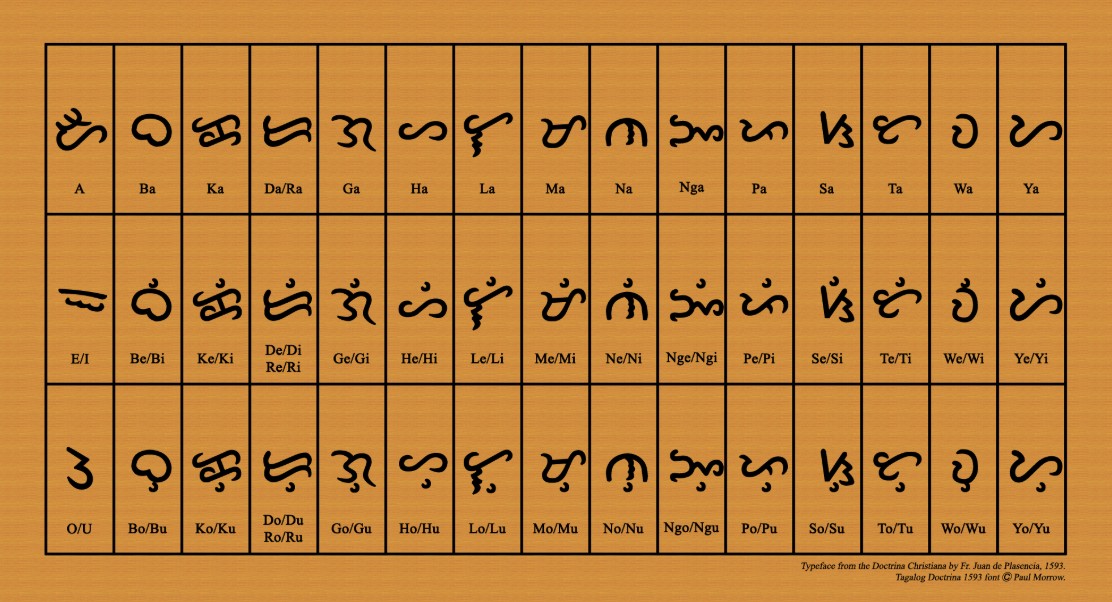
You’ve probably seen it on a t-shirt, a tattoo, a mug, a government building or a friend’s Instagram bio: those curved, elegant symbols that look like a cross between art and code. That’s Baybayin, the ancient writing system of the Philippines. It’s one of the most beautiful pieces of Filipino heritage, and it’s easier to learn than you might think.
This guide explains what Baybayin is, where it came from, how it works, and where to start learning for free, a great weekend project for curious kids and grown-ups alike.
What Is Baybayin?
Baybayin is a pre-colonial Philippine script that was used long before the Spanish arrived. The name comes from the Tagalog word baybay, which means “to spell.”
Baybayin is not an alphabet like the one used for English. It’s an abugida (also called an alphasyllabary), where each character stands for a consonant plus a vowel sound. Think of each symbol as a syllable, such as ba, ka or sa, rather than a single letter.
It has 17 characters: 3 vowels and 14 consonants.
A Short History
- Origins: Scholars believe Baybayin belongs to the family of Brahmic scripts from South and Southeast Asia, probably reaching the islands through trade and cultural exchange, with Kawi from Java often mentioned as a relative. The exact route is still debated.
- Early evidence: The oldest known written document found in the Philippines is the Laguna Copperplate Inscription, dated to around the year 900. It’s written in a related Indic script rather than Baybayin itself.
- Everyday use: Before and during early Spanish contact, Baybayin was used for personal notes, poetry, trade and correspondence, mainly in Luzon, and was adapted for several languages including Tagalog, Ilocano, Kapampangan, Pangasinan, Bisaya and Bikol.
- Printed Baybayin: The Doctrina Christiana of 1593, one of the earliest printed books in the Philippines, includes Tagalog written in Baybayin alongside the Latin alphabet.
- Decline: As Spanish colonial rule spread, the Latin alphabet took over schools, churches and government records. Baybayin faded through the 17th and 18th centuries and survived in only a few documents, artifacts and books.
- Revival: Today there is renewed interest in Baybayin through art, education, design and heritage projects. It also has its own block in Unicode (called “Tagalog”), so it can be typed on computers and phones.
A common mistake: “alibata”
You may have heard Baybayin called “alibata.” That name was coined in the 20th century, and scholars say it’s inaccurate. It was based on a mistaken idea that the script came from Arabic. The correct name is Baybayin.
How Baybayin Works
Here’s the basic idea in four steps.
1. Each character already has an “a” sound. The symbol for ka is just ka, the one for ba is ba, and so on.
2. A kudlit changes the vowel. The kudlit is a small mark added to a character:
- a mark above changes the sound to e or i
- a mark below changes the sound to o or u
Mixing up the placement is the most common beginner error, so practice it early.
3. Vowels at the start of a syllable have their own characters. Only three exist: A, E/I and O/U.
4. Ending a syllable with a consonant needs a special mark. The original script had no way to write a lone consonant, so words like bundok were often written without their final sounds and readers filled them in from context. In 1620, the Spanish priest Francisco López introduced a cross-shaped kudlit (called the krus-kudlit or virama) that cancels the “a.” Many modern writers use it, though some prefer the traditional style.
Try it: writing “Baybayin”
Broken into syllables, it’s bay-ba-yin:
ᜊᜌ᜔ᜊᜌᜒᜈ᜔
That’s ba + ya with the cross mark, then ba + ya with the “i” kudlit + na with the cross mark. Use the translator at Kuya Bai (below) to check your own words.
Some details vary: Baybayin was never fully standardized, and writers still make different choices on spelling, double vowels, and how to treat foreign words and names. If you’re writing something permanent, like a tattoo or a sign, check it with a knowledgeable speaker first.
Learn Baybayin Free with Kuya Bai
If you want to go beyond the history, Kuya Bai is a free online platform for learning Baybayin, for learners in the Philippines and around the world. Here’s what the site offers:
- Tagalog to Baybayin translator: type in Tagalog, see it in Baybayin, then copy or download the result. It’s good for checking your homework or making something personal.
- Free eLearning course: lessons you can take at your own pace, from “What is Baybayin?” to the characters themselves.
- Games for practice: links to ready-made Baybayin games and flash cards on Baamboozle, Quizlet and Kahoot!, which are perfect for kids and for anyone who learns by playing.
- Free worksheets: a downloadable PDF set you can print and practice with. (If you want a calendar or planner to schedule practice, see our QuickCalendars article.)
- Free font: the site links to the Baybayin Namin OpenType font so you can type Baybayin in your own documents and designs.
- Resources and communities: links to other places to learn and connect with fellow Baybayin enthusiasts.
The site credits the open-source Philippine Scripts Translator project by jennayey for the translator, and says it’s made by the team at Proaxial. Its tagline sums up the mission: “Baybayin ay buhayin!” (Let’s keep Baybayin alive!)
Related Scripts
Baybayin isn’t the only indigenous Philippine script. Others include the Hanunó’o, Buhid and Tagbanwa scripts, which are still used by some Mangyan and Palawan communities today, plus the Kapampangan script (kulit) and the Bisaya script (badlit). Kuya Bai’s site keywords mention several of these, which is a good sign that there’s more to explore after you finish the basics.
A Simple 7-day Plan For Families
- Day 1: Read about what Baybayin is, then try the translator with your own names.
- Day 2: Learn the 3 vowels.
- Day 3: Learn the first half of the consonants.
- Day 4: Learn the rest, then take a quiz or play a game together.
- Day 5: Practice the kudlit with a printed worksheet.
- Day 6: Write a short message, like a birthday card or a note for the fridge.
- Day 7: Write a family name sign for a bedroom door.
Why It Matters
Baybayin is more than pretty symbols. It’s proof that Filipinos were reading and writing long before colonial rule, and learning it connects us with that history. For travelers, it’s also a nice way to understand the designs you’ll see on souvenirs, murals and museum displays around the country.
Start learning here: Kuya Bai: Learn Baybayin
Related Articles:
– 25+ Best SEO Tools that SEO Experts Actually Use
– How SEO Professionals Can Optimize Your Entire Digital Strategy
– TOP 20 Web Hosting Services of 2024 (Experts Choice)
– How to Start a Blog in 2024 – 10 Super Easy Steps + Bonus Tips
– 15 Best Affiliate Programs of 2022 which are High Paying for Beginners
